
Volume discounts and quantity breaks
A volume discount takes money off when a customer buys or spends enough. It’s what other apps call quantity breaks, tiered pricing, or a bulk or wholesale discount. Three discount types work this way, and this page covers all three:
- Volume discount: quantity tiers (quantity breaks), for example 10% off 2 or more of a T-shirt and 20% off 5 or more. The steps are just below.
- Spend tiers: tiers by amount spent, for example $10 off when a customer spends $100 and $25 off at $200. See spend tiers.
- Group price: a price for a group of items, for example 3 for $50 and 6 for $90. See group prices.
Each applies automatically at checkout, or only when the customer enters its code, such as BULK. To show the tiers on product pages before checkout, add the Quantity breaks or Mix and match block.
Plan: Deals & Rules or Buddy. Works on all Shopify plans. It appears on the Discounts page in Shopify admin, titled with the discount’s Title. Clicking it there opens it in Checkout Buddy.
Create a volume discount
Section titled “Create a volume discount”These steps make quantity breaks: 10% off 2 or more of a product, and 20% off 5 or more.
-
In Checkout Buddy, open Customizations. On the Discounts tab, click Create customization, then the Discounts card.
-
Under Type, choose Volume discount (under Tiers and combos). If the page opened on another type, click Change next to it and choose again. Searching “volume”, “tiered”, “bulk”, “wholesale” or “quantity break” before you click the card opens it with Volume discount chosen.
-
Under Method, keep Automatic discount, or choose Discount code and enter the code in the Discount code card. Give the discount a Title.
-
In the Offer card, under Counts toward the tiers, keep Specific products and click Add products. For a whole range, choose Collections or Product tags instead, or All items for every product.
-
Under Tiers, fill in the two rows: Buy at least
2with Percentage off10, and Buy at least5with20. Click Add tier for another. -
Change the Message at checkout, which customers see next to the discount, such as
Buy more, save more. -
Click Save in the bar at the top of the page. The discount is live straight away.
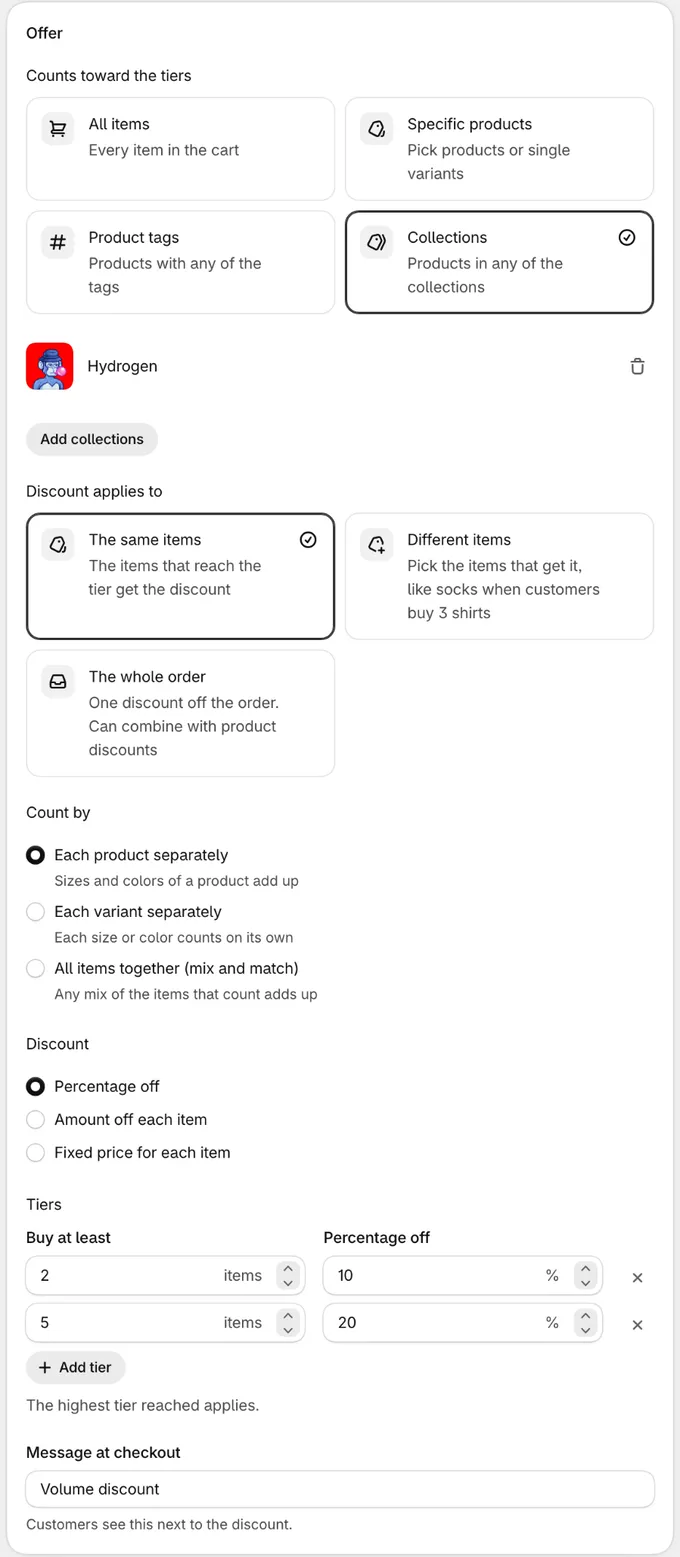
As set up here, sizes and colors of one product add up toward a tier, and each product reaches its tiers on its own. The table shows what to change for other deals:
| You want | Change |
|---|---|
| Case or wholesale pricing, such as $8 each when a customer buys 12 or more | Discount: Fixed price for each item. See the examples |
| Mix and match, such as $2 off each when a customer buys any 3 items from a “Socks” collection | Count by: All items together (mix and match). Buyers can pick the items on a product page with the Mix and match block |
| A price for a group, such as 3 for $50 and 6 for $90 | The Group price type. See group prices |
| Spend more, save more, such as 10% off at $100 and 20% off at $200 | The Spend tiers type. See spend tiers |
| A discount on different items, such as 20% off a brand’s products when a customer buys any 10 other items | Discount applies to: Different items. See different items |
| A discount off the whole order, such as 10% off the order with any 3 items from a “Snowboards” collection | Discount applies to: The whole order. See the whole order |
| Tiers for some customers only, such as an email list or an influencer’s followers | Method: Discount code. A code doesn’t use one of your store’s 25 automatic discounts |
| A cap, such as 20% off but no more than $50 an order, or the discount on 6 items at most | The Limits card |
| Buy 2, get 1 free | A Buy X get Y discount instead |
Watch one set up in the setup video, from 0:13: 10% off 2 boards and 15% off 3.
Start from a template
Section titled “Start from a template”Under Templates → Discounts:
- Buy 2, save 10%; buy 3, save 15%: any items count together, store-wide.
- Spend $100, save 10%; $200, save 20%: a Spend tiers discount, store-wide.
- Mix and match: any 3 for $50: a Group price discount on any mix of the products you pick.
- Buy more, save more, a recipe in 2 steps: the same discount, then a progress bar whose goals are its tiers, in checkout on Shopify Plus or on your cart page without it. See templates and recipes.
Quantity breaks, Mix and match: any 3 for $50 and Buy the set, save 20% are also under the Bundles tile. They set up in 2 steps: the discount, then its block for product pages.
Or start from Shopify admin: on the Discounts page, click Create discount and choose Volume discount. For spend tiers or a group price, click Change next to the type and choose it.
You can switch to another discount type until you save. If you’ve already filled in the page, Checkout Buddy asks first. The title, status and active dates stay. Everything else starts over, including Combinations and Discount applies to.
Group prices
Section titled “Group prices”A Group price discount sells items in groups at a set price, like 3 for $50 and 6 for $90. Each full group costs its price. Leftover items cost full price. The Summary shows it as “3 for $50.00”.
To set one up:
- Create a discount as above, and choose Group price under Type. Searching “group price” or “3 for $50” first opens it chosen.
- In the Offer card, pick the items under Counts toward the tiers.
- Under Groups, enter Group of
3and Price for the group50. Click Add group size for another, such as 6 for 90. - Click Save.
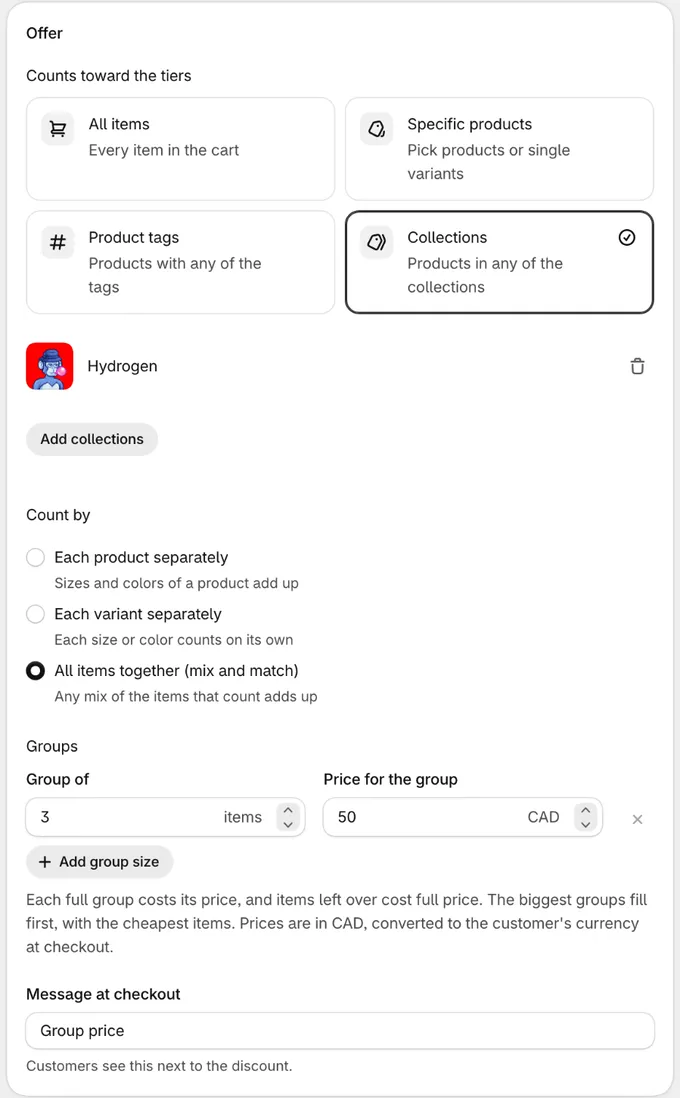
A new group price starts with Count by set to All items together, so any 3 of the items make a group. The Mix and match: any 3 for $50 template fills these in.
Think of a six-pack: with 6 for $10 on a $2 can, 7 cans cost $12, a six-pack for $10 and one can at $2. Fixed price for each item can’t do that: “$1.67 each from 6 cans” makes all 7 cans $1.67 ($11.69), and even 6 cans come to $10.02. Use Group price when your deal is a pack price, and Fixed price for each item when every item should get cheaper once customers buy enough, extras included.
For a $20 T-shirt, with groups of 3 for $50 and 6 for $90:
| Cart | Customer pays |
|---|---|
| 3 T-shirts | $50 |
| 4 T-shirts | $50 + $20 = $70 |
| 6 T-shirts | $90 |
| 7 T-shirts | $90 + $20 = $110 |
- The biggest groups fill first. 7 T-shirts make one group of 6 and one T-shirt at full price, not two groups of 3.
- The cheapest items fill the groups. With items at different prices, the dearest ones are the ones left over at full price.
- A group that isn’t cheaper takes nothing off. If 3 items already cost less than the group price, they keep their own prices.
- Count by works as for the other types: with Each product separately, groups form within each product; with All items together, any mix of the items that count fills a group.
- Group prices are in your store’s currency, converted to the customer’s currency.
A group price always applies to the same items, so it has no Discount applies to choice. For a pack price on different items, use a Volume discount with Fixed price for each item. Combo discounts don’t have group prices.
Spend tiers
Section titled “Spend tiers”In a Spend tiers discount, the tiers are what a customer spends on the items that count, before discounts, such as $10 off at $100 and $25 off at $200.
To set one up:
- Create a discount as above, and choose Spend tiers under Type. Searching “spend tiers” or “spend more save more” first opens it chosen.
- In the Offer card, pick the items under Counts toward the tiers, or All items for the whole cart.
- Under Discount, choose Percentage off or Amount off. To take it off the whole order instead of off these items, set Discount applies to to the whole order.
- Under Tiers, enter each Spend at least amount and its value, such as
100with10and200with25. - Click Save.
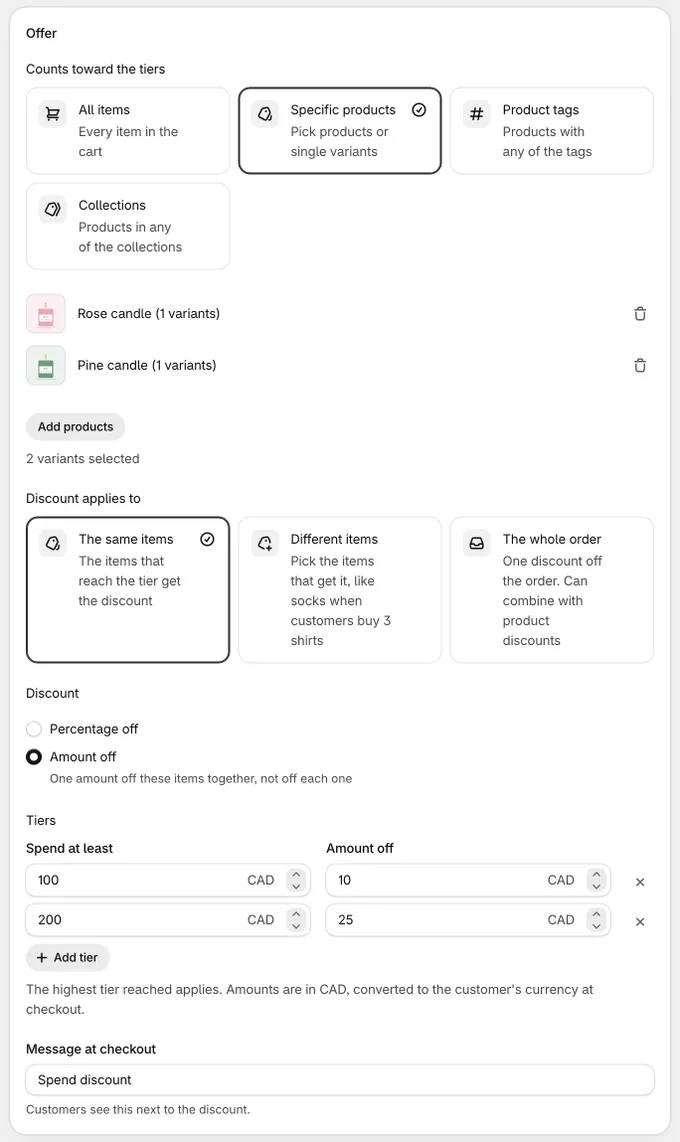
Amount off is one amount off the items together, which Shopify shares across them by price. For example, with a “Snowboards” collection and tiers of $1,000: $50 off and $2,000: $150 off, $150 off a $885.95, a $600 and a $629.95 board comes off as $62.80, $42.54 and $44.66.
Spend amounts and Amount off are in your store’s currency, converted to the customer’s currency.
Settings
Section titled “Settings”Discount
Section titled “Discount”- Type: Volume discount, Spend tiers or Group price.
- Method: Automatic discount applies at checkout when the conditions pass. Discount code applies when the customer enters the code.
- Title: Shown on Shopify’s Discounts page. Customers see the discount message or code. Must be unique among your customizations.
After you save, the type and method can’t change.
Counts toward the tiers decides which items add up toward a tier:
| Counts toward the tiers | Covers |
|---|---|
| All items | Every item in the cart. |
| Specific products (default) | The products and variants you pick with Add products. Only the variants you pick count. |
| Product tags | Products with any of the tags in Product tags. Separate tags with commas. Capitals don’t matter. |
| Collections | Products in any of the collections you pick with Add collections. |
Only the choice you make is saved. If you switch, the products, tags or collections of the other choices are dropped when you save.
Discount applies to decides what gets the tier’s discount. A Group price discount doesn’t have it: it always applies to the same items.
| Discount applies to | What the customer gets |
|---|---|
| The same items (default) | A discount on each item that counts, shown on the items in cart and checkout. |
| Different items | A discount on each of the items you pick under Items that get the discount, shown on those items. They don’t count toward the tiers: the other items that count decide the tier. See different items. |
| The whole order | One discount off the whole order, minus optional exclusions. It can combine with product discounts. See the whole order. |
After you save, you can still switch between The same items and Different items, but not to or from The whole order: it’s a different kind of Shopify discount (an order discount instead of a product discount). To switch, create a new volume discount.
Count by decides how items add up toward a tier. With a tier at 3 items:
| Count by | What adds up | Example |
|---|---|---|
| Each product separately (default) | All sizes and colors of one product | 2 small and 1 large of the same T-shirt make 3, so all three are discounted. |
| Each variant separately | Each size or color on its own | 2 small and 1 large of the same T-shirt don’t reach 3. |
| All items together (mix and match) | Any mix of the items that count | 1 T-shirt and 2 hoodies make 3, so all three are discounted. |
A new Volume discount starts on Each product separately, and a new Group price on All items together, so any 3 of the items make a group.
Count by is only there with The same items: different items and the whole order get one tier for the whole cart, so their items count all together. A Spend tiers discount doesn’t have it either: it always adds up what the items that count cost together. With a tier at $100, a $60 T-shirt and a $50 hoodie make $110, so both are discounted. See spend tiers.
Discount decides what each tier gives:
- Volume discount, on items: Percentage off, Amount off each item, or Fixed price for each item. See the examples.
- Spend tiers, on items: Percentage off or Amount off: one amount off these items together.
- On the whole order: Percentage off the order or Amount off the order.
- Group price has no Discount choice: each tier is a price for a group. See group prices.
Tiers: Each row is one tier.
- Buy at least: The number of items that reaches the tier. Whole numbers of 1 or more, and no two tiers can have the same number. For Spend tiers, it’s Spend at least: an amount in your store’s currency, 1 or more, with up to 2 decimals.
- The value: Percentage off (up to 100), Amount off each, Price for each or Amount off, depending on Discount. Amounts are in your store’s currency.
- For Group price, each row is a group instead: Group of (how many items) and Price for the group.
- New volume discounts start with tiers at 2 and 5 items, spend tiers at $100 and $200, and group prices with one group of 3. Fill in their values, click Add tier (or Add group size) for another, or click the X on a row to remove it. A discount needs at least one tier, so the last row’s X is greyed out. You can enter tiers in any order; they’re sorted when you save.
Message at checkout: The label customers see next to the discount. Defaults to Volume discount, Spend discount for spend tiers and Group price for group prices, and Volume discount is used if you leave it empty. On a discount code, customers see the code instead.
Limits
Section titled “Limits”Optional, and empty to start. Discounts with limits don’t show on product page blocks.
- Most it takes off an order: the most this discount takes off one order, in your store’s currency, such as 50 for “20% off, up to $50”. Leave it blank for no limit.
- Most items that get it: at most this many items get the discount, the cheapest first. It’s a whole number from 1; leave it blank for no limit. With The same items, every item still counts toward the tiers. With Different items, only the items that get it are left out of the count. It’s there with a percentage, an amount off each item or a fixed price for each item, not with a group price, the Amount off of spend tiers, or The whole order.
- Items already on sale, items whose compare-at price is above their price:
- Discount them as usual (default).
- Don’t discount them. They still count toward the tiers.
- Discount them from the compare-at price, with a percentage or an amount off each item. At 30% off, an item marked down from $100 to $80 sells for $70, not $56. At $15 off, an item marked down from $100 to $95 sells for $85, not $80.
- Purchase type, not on The whole order: One-time purchases and subscriptions (default), One-time purchases only or Subscriptions only. Items of the other type don’t count toward the tiers and get no discount. With Different items, every item that counts still counts, and only the items that get the discount must be of the type. Shopify counts an item as a subscription when it’s bought on a selling plan with recurring deliveries: pre-orders and try before you buy are one-time purchases.
The Summary lists each limit you set, such as “At most $50.00 off an order”.
Discount code
Section titled “Discount code”Only with Discount code.
- Discount code: The code customers enter at checkout to get the tiers, such as
BULK. Capitals don’t matter. - Limit to one use per customer
- Apply usage limit: The number of times the code can be used in total.
The tiers work as on an automatic discount: with BULK set to 2 items: 10% off and 3 items: 15% off, a customer who enters BULK with one item gets nothing yet, and 10% off once a second one is in the cart.
Combinations
Section titled “Combinations”Combines with order discounts, Combines with product discounts, Combines with shipping discounts: Whether this discount can be used together with other discounts of each kind. All are off by default. Shopify only combines two discounts when both allow it.
Active dates
Section titled “Active dates”Tick Set specific start date and Set specific end date to schedule the discount. Without a start date, it starts when you first save it, and saving it again keeps that date. Without an end date, it doesn’t end.
Summary
Section titled “Summary”The Summary card shows what the discount does as you fill it in, for example “2+ items: 10% off · 5+ items: 20% off” and “Applies with the code BULK”.
How the tier is chosen
Section titled “How the tier is chosen”- The discount finds the cart items under Counts toward the tiers, and adds up their quantities as set in Count by, or their prices for spend tiers.
- Each group gets the tier with the highest Buy at least that its quantity reaches. Below the lowest tier, there’s no discount.
- Every item that gets the discount gets that tier’s discount, not only the items above the tier’s quantity.
For example, with tiers of 2 items: 10% off and 5 items: 20% off, Each product separately, and a “Tops” collection, a cart with 4 of the same T-shirt (any mix of sizes) and 1 hoodie gets 10% off all 4 T-shirts and nothing off the hoodie. A fifth of that T-shirt moves all 5 to 20% off.
With Different items or The whole order, the items that count add up all together, and the tier’s discount goes on the picked items or comes off the whole order, minus its exclusions. With Different items, the items that get the discount are left out of the count.
Examples
Section titled “Examples”Tiers at 3 and 6 items, for a $20 T-shirt:
| Discount | Tier values | 4 T-shirts | 6 T-shirts |
|---|---|---|---|
| Percentage off | 10 and 20 | $18 each ($72) | $16 each ($96) |
| Amount off each item | 2 and 5 | $18 each ($72) | $15 each ($90) |
| Fixed price for each item | 17 and 15 | $17 each ($68) | $15 each ($90) |
When the items have different prices, the three types differ more:
- Percentage off takes the same share off every item.
- Amount off each item takes the same amount off every item. An amount bigger than an item’s price makes that item free, never less than zero.
- Fixed price for each item brings every item down to the same price. An item that already costs that price or less isn’t discounted, but it still counts toward the tier. For example, with All items together and a tier of 3 items at 15, a cart with 2 T-shirts at $20 and a cap at $12 reaches the tier: the T-shirts drop to $15 and the cap stays at $12.
Amount off each item and Fixed price for each item are in your store’s currency, converted to the customer’s currency.
Different items
Section titled “Different items”With Discount applies to set to Different items, the items that count decide the tier, and only the items you pick under Items that get the discount get it, such as 20% off a brand’s products when a customer buys any 10 other items.
- Items that get the discount: Specific products, Product tags or Collections, picked like Counts toward the tiers.
- The items that get the discount don’t count toward the tiers, even when they’re also under Counts toward the tiers. “Spend $100 on anything, socks free” needs $100 spent on items other than the socks.
- Only the items that really get it are left out. With Most items that get it under Limits, only those items (the cheapest) are left out of the count. Items that get nothing at the tier still count, such as items already at or under a Fixed price for each item, or items on sale with Don’t discount them.
- The items that count add up all together: how many of them for a Volume discount, what they cost for Spend tiers.
- Discount, Tiers and Message at checkout work as on the same items. Amount off (spend tiers) is one amount off the picked items together.
- Pick other items than the ones that count. When Items that get the discount picks exactly the items under Counts toward the tiers, the page warns These are the items that count. With the same items in both places, the discount never applies. Choose The same items instead, or pick different items.
For example, counting All items, with tiers of 5 items: 10% off and 10 items: 20% off, and products tagged brand-x getting the discount:
| Cart | Discount |
|---|---|
| Four T-shirts and a $50 Brand X cap | None: the cap gets the discount, so only the 4 T-shirts count, and 5 are needed |
| Five T-shirts and a $50 Brand X cap | 10% off the cap: $5 off |
| Nine T-shirts and a $50 Brand X cap | 10% off the cap: $5 off. 9 items count, and 10 are needed for 20% |
| Ten T-shirts and a $50 Brand X cap | 20% off the cap: $10 off |
| Ten T-shirts | None: nothing in the cart is picked to get the discount |
The whole order
Section titled “The whole order”With Discount applies to set to The whole order, a volume or spend tiers discount is one discount off the whole order, such as $50 off when a customer spends $1,000 (Spend tiers), or 10% off the order when they buy any 3 snowboards (Volume discount). This was the Order volume discount type.
- Counts toward the tiers: All items (the default here, when nothing is picked yet), or only Specific products, Product tags or Collections. These items count all together: how many of them are in the cart for a Volume discount, or what they cost together, before discounts, for Spend tiers.
- Discount: Percentage off the order, or Amount off the order, a flat amount. It comes off the whole order, including items that don’t count toward the tiers.
- Exclusions (optional): Exclude products, Exclude collections and Exclude products with tags. Excluded items get no discount. Gift cards are never discounted. Exclusions don’t change what counts toward the tiers: to stop an item counting, leave it out of Counts toward the tiers.
- Tiers and Message at checkout work as on the items that count.
- A whole-order discount saved between October 5 and November 1, 2026 with Amount off each item or Fixed price for each item keeps that choice, with the note “No longer offered for the whole order. It keeps working until you pick another.”
For example, counting a “Snowboards” collection, with tiers of 3 items: 10% off and 5 items: 15% off, and ski wax excluded:
| Cart | Discount |
|---|---|
| Two $600 snowboards and a $200 jacket | None: only the 2 snowboards count |
| Three $600 snowboards, a $200 jacket and $20 ski wax | 10% off $2,000 (everything but the wax): $200 off |
| Five $600 snowboards and $20 ski wax | 15% off $3,000: $450 off |
With Spend tiers, the tiers count only what’s spent on those items: three $600 snowboards and a $3,000 tent reach a $1,000 tier, not a $4,000 one, and the discount still comes off the tent too.
Conditions
Section titled “Conditions”The Conditions card decides when the discount applies. It works like the Conditions card of other functions, without condition sets.
- Apply to all checkouts: The default.
- Apply only when conditions pass: Click Add condition and pick one or more conditions. Inside a group, OR adds another condition, and one of them has to pass. AND adds a new group, and every group has to pass. See how conditions work.
Switching between the two clears the conditions you’ve added. Volume discounts don’t have Export and Import for conditions.
| Category | Conditions |
|---|---|
| Cart | Cart subtotal, Cart products, Cart collections, Quantity of items in collections, Quantity of unique variants in collections, Total value of items in collections, Number of items, Number of line items, Cart has items on sale, Cart currency, Quantity of variants, Quantity of items with product tags |
| Line item | Line item product tags, Line item product type, Line item vendor |
| Customer | Customer tags, User is a customer |
| B2B | B2B customer exists, B2B customer does not exist |
| POS | Is POS checkout, Is not POS checkout, POS location ID |
- Conditions look at the whole cart. Number of items counts every item in the cart, while the tiers only count the items under Counts toward the tiers.
- “is more than” is strict. is more than 5 means 6 or more.
- Money conditions such as Cart subtotal use your store’s currency and are converted for the customer.
- Customer tags only work for logged-in customers. A guest has no tags, so includes fails and does not include passes.
- Cart currency is is one of or is not one of a list of currency codes, such as
EUR, GBP. - Line item product type and Line item vendor pass with includes when any item in the cart has one of the types or vendors you add. Add each on its own, so a name with a comma like
Acme, Inc.stays one name. Capitals don’t matter. - Cart has items on sale passes when any item has a compare-at price above its price.
- B2B customer exists passes when the buyer is buying for a company. Is POS checkout passes for orders in your Shopify POS, and POS location ID for the location IDs you list.
- When the conditions don’t pass, no item gets the discount.
Things to know
Section titled “Things to know”- Only the items under Counts toward the tiers count toward a tier. Gift cards and custom items never count and are never discounted. With Specific products, only the variants you picked count, even with Each product separately.
- New variants aren’t added for you. Picking a product picks the variants it has at that moment. If you add a variant to the product later, select it in Add products and save. The same goes for the Cart products and Quantity of variants conditions. Product tags and collections are read each time checkout runs, so products you tag or add to a collection later are included.
- Give higher tiers bigger discounts. The tier is picked by quantity, not by which discount is bigger, and Checkout Buddy doesn’t check the order of your values. With 2 items: 20% off and 5 items: 10% off, adding a fifth item drops every item from 20% to 10% off: four $20 items get $16 off, but five get only $10 off.
- One set of tiers per discount. For different tiers on different products, create another volume discount. Each automatic one counts toward Shopify’s limit of 25 active automatic discounts; codes don’t.
- One code per discount. For a second code with the same tiers, create another volume discount. A code discount can’t be duplicated, since two discounts can’t share a code.
- Some markets only: choose Specific markets under Eligibility. See customer segments and markets.
- Converted prices aren’t rounded like your market prices. In another currency, a Fixed price for each item is your price converted at Shopify’s exchange rate, such as 13.81. On multi-currency stores, percentages are the simplest choice.
- Use product tags or collections for big selections. Saving fails when the offer (with its other items or exclusions) and its conditions together use more than 100 different product tags, more than 100 collections or more than 100 customer tags, or pick more than about 150 variants one by one, Shopify’s limit per discount. The page warns you once the offer and its conditions pick more than 10 variants.
- Big carts and many tags or collections. With many product tags and collections in the offer and its conditions, a big cart can hit Shopify’s limits and get no discount. With 10 collections that happens at about 150 cart lines, and with 40 at about 45. The page warns you with Big carts may not get this discount once there are more than 10. Use fewer, broader tags or collections.
- Very big carts. When more than roughly 90 cart lines each get a different amount off, which can happen with Fixed price for each item, Shopify’s size limit means the smallest discounts are left off. A discount off the whole order isn’t affected.
- Show the tiers on product pages with the Quantity breaks and Mix and match theme blocks, like Buy 2, save 10% cards or an Any 3 for $50 picker. They show automatic discounts for all customers, without limits.
- Discounted prices don’t show inside older blocks. Older Product offers and other older product blocks only preview automatic product discounts. New Product offers show the price text you write.
- If a discount isn’t applying, work through discount not applying.